
Monday, August 29, 2016
Welcome Southdale Families!
Hello! My name is Mrs. Thilges (Til-jes), many students call me Mrs. T. This is my 3rd year at Southdale Elementary serving as the school counselor. I enjoy working with elementary students and can't wait to get to know you and your child better. I hope to use this blog to help parents stay connected with what your child is learning in counselor visits this year, along with other important information. Please do not hesitate to contact me with any questions or concerns, I am happy to help. My email is: emily.thilges@cfschools.org and my Phone number is: 319-553-2992


Monday, November 23, 2015
Tuesday, November 4, 2014
Monday, October 14, 2013
1st Grade Guidance Class- Tower of Trust
This is such a fun lesson because my students get such a kick out of how high they think they can build the "Tower of Trust" before it comes crashing to the ground. I wish I would have gotten a picture of them and their nervous looking faces as I added brick by brick!
At the beginning of the lesson we talk about what the word trust looks like and 1st graders have EXCELLENT examples of how they can be trusted. Some of them shared how they can go to a neighbor's house all by themselves to play with a friend, some said that they help their parents cook or bake, some shared how they help with farm and yard work, and some also shared how they have jobs they need to do at their homes and how they do them right away. I had one little boy tell me that whenever his mom tells him to turn off his Nintendo DS, he turns it off right away, every. single. time. (I wish I had that happening at my house!)
On index cards students either write or illustrate a way they can be trusted and then we get started by taping them to my big cardboard bricks and building a "Tower of Trust" (which must be said in a loud, ominous voice :).
We have a great discussion about how trust isn't given right away, it must be built brick by brick, behavior by behavior. We then talk about how 1 negative behavior affects the tower of trust, and if that happens over and over again, what kind of mess we are left with when it comes crashing to the ground.
At the beginning of the lesson we talk about what the word trust looks like and 1st graders have EXCELLENT examples of how they can be trusted. Some of them shared how they can go to a neighbor's house all by themselves to play with a friend, some said that they help their parents cook or bake, some shared how they help with farm and yard work, and some also shared how they have jobs they need to do at their homes and how they do them right away. I had one little boy tell me that whenever his mom tells him to turn off his Nintendo DS, he turns it off right away, every. single. time. (I wish I had that happening at my house!)
On index cards students either write or illustrate a way they can be trusted and then we get started by taping them to my big cardboard bricks and building a "Tower of Trust" (which must be said in a loud, ominous voice :).
We have a great discussion about how trust isn't given right away, it must be built brick by brick, behavior by behavior. We then talk about how 1 negative behavior affects the tower of trust, and if that happens over and over again, what kind of mess we are left with when it comes crashing to the ground.
Thursday, October 10, 2013
3rd Grade Guidance Class- Friendship Pie
In third grade I am encouraging students to think about what kinds of characteristics make good friends, and a great book to help get us thinking about this is, Enemy Pie by Derek Munson. In this book a new boy moves into the neighborhood and becomes the narrator's #1 enemy. Thankfully, his dad has an old recipe for Enemy Pie that helps get rid of them. All that he must do is spend one entire day with the new kid, and then have enemy pie for dessert. Soon, the narrator realizes that Jeremy Ross is actually a friend and that enemy pie is really delicious.

After reading the story, students we able to create their own "Friendship Pie" recipes using ingredients that make friendships delicious too!

After reading the story, students we able to create their own "Friendship Pie" recipes using ingredients that make friendships delicious too!
Wednesday, October 9, 2013
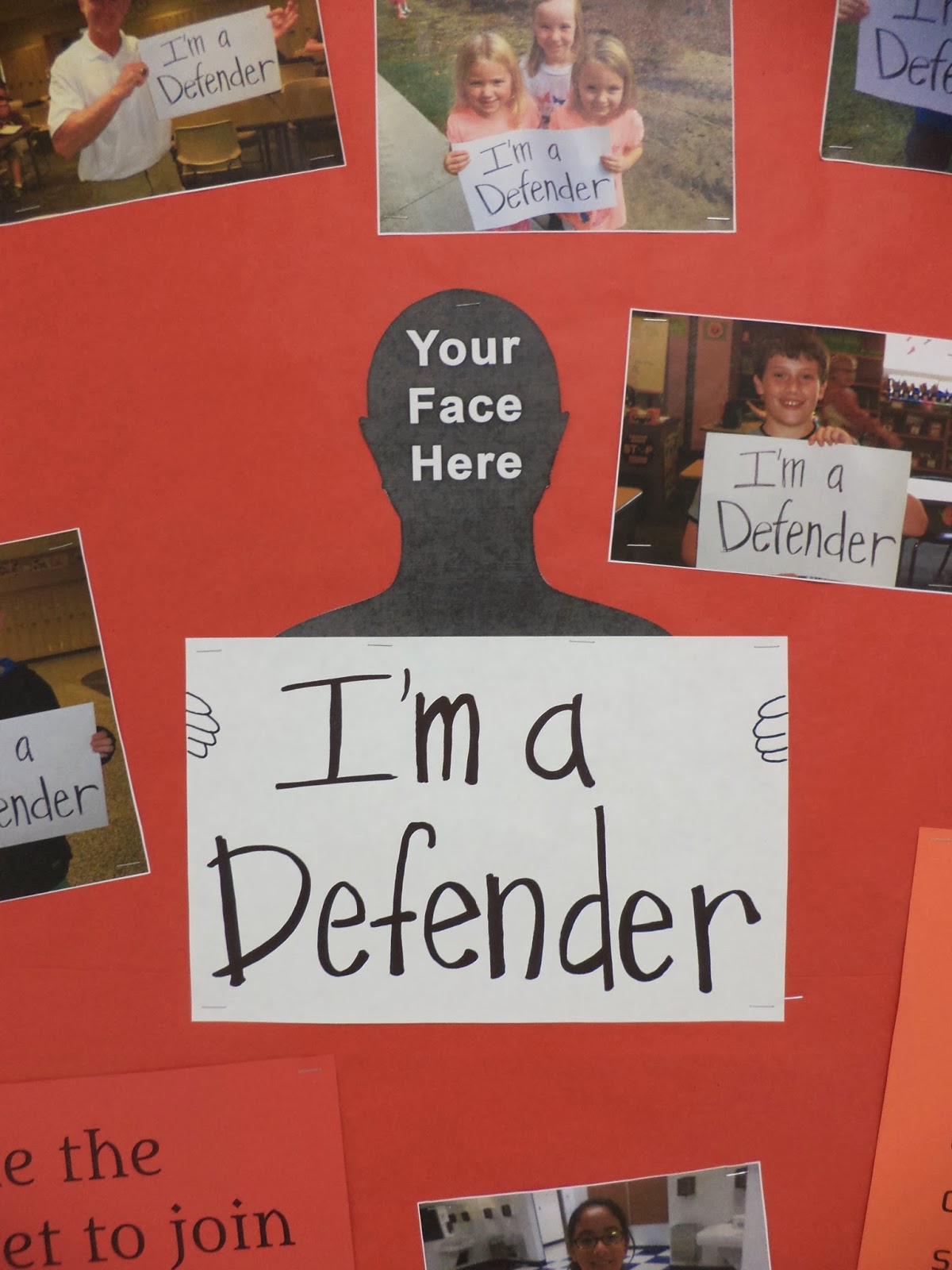
Denver Defender Bulletin Board
Each month I try to add a new bulletin board to the hallway on the way to the cafeteria. This month I am really focusing on ways that students can be a Defender (stand up for others) WITHOUT having to say much- or say anything at all. Some kids think that they aren't bold enough to be a defender, but ANYONE can do it!




Monday, October 7, 2013
4th Grade Guidance Class- Reframing
I always start this lesson off by saying how excited I am to be able to teach my 4th graders a very "fancy" counseling word that I learned in my Master's program. Kids think that this is pretty cool and get excited to learn a college word!
We then get started with learning about "reframing". Being able to give a negative experience or conversation a positive spin, is a wonderful skill to have. Students can begin to see the bigger picture in things that they are going through, and look at things through different lenses.

I read one of my very favorite stories, Alexander and the Terrible, Horrible, No Good, Very Bad Day by Judith Viorst. We then go through the book and work at reframing Alex's negative experiences from his day into something more positive.
Lastly, students work together in small groups to create a skit to perform to the class that displays reframing. Examples that they have to choose from are: "My brother won't stay out of my room", "My parents won't let me go see the new scary movie", "I got an F on my test", "I didn't get what I wanted for my birthday", "I didn't get invited to the bowling party" or, "My friends wouldn't play with me at recess". You can probably only imagine how much fun they have with this task!
We then get started with learning about "reframing". Being able to give a negative experience or conversation a positive spin, is a wonderful skill to have. Students can begin to see the bigger picture in things that they are going through, and look at things through different lenses.

I read one of my very favorite stories, Alexander and the Terrible, Horrible, No Good, Very Bad Day by Judith Viorst. We then go through the book and work at reframing Alex's negative experiences from his day into something more positive.
Lastly, students work together in small groups to create a skit to perform to the class that displays reframing. Examples that they have to choose from are: "My brother won't stay out of my room", "My parents won't let me go see the new scary movie", "I got an F on my test", "I didn't get what I wanted for my birthday", "I didn't get invited to the bowling party" or, "My friends wouldn't play with me at recess". You can probably only imagine how much fun they have with this task!
Subscribe to:
Posts (Atom)